The 5AM Brain Trust

5oclock

I get some of my best ideas at 5AM.

At 5AM, only the members of my brain trust are present. That would be me, whatever that rattling noise is whenever the air conditioning is blowing, the hum of the fan, and my husband’s sometimes loud and erratic breathing. Unfortunately – or maybe fortunately, I’m the only one doing any thinking.

For me, 5AM is my creative refuge from the chaos of mental input that can be the rest of my day.

In March of 2014, I suffered a brain bleed while at work. Two months later in May of 2014, I suffered a second stroke following an angiogram, but this time it was a blockage. I was subsequently diagnosed with a cognitive processing delay. As a result, I forget things. Sometimes immediately. I get distracted easily. I get up to go downstairs, see that there are dishes in the sink, clean the ENTIRE kitchen plus takeout the trash, water the plants, choose new wallpaper, and then go back upstairs without ever retrieving the load of dried laundry I set out to get in the first place. My mind is always racing. There are always a couple handfuls of thoughts grappling for distinction. On more than one occasion, I’ve found myself at traffic lights and couldn’t remember where I was going once they turned green because I was off on some mental tangent.

Sometimes, when there are too many things going on, I have trouble sorting them out. Like too many people trying to talk to me at one time. My brain can no longer sort the voices and focus on just one. It hears them all at the same time, and it’s too much.

So at 5AM, when everything that would serve as a distraction is still on pause from the overnight, I can think and let my mind wander with clarity. My characters, my stories, my ideas – they all come to life. I can follow long trains of detailed thought into story lines and logic. Sometimes, I even come up with some majorly fantastic stuff! However, holding on to that fantastic stuff can be like chasing bouncing marbles around in a funnel.

That being said, until some other member of my brain trust volunteers to take minutes, the struggle to get the ideas from here to there will continue to be real.
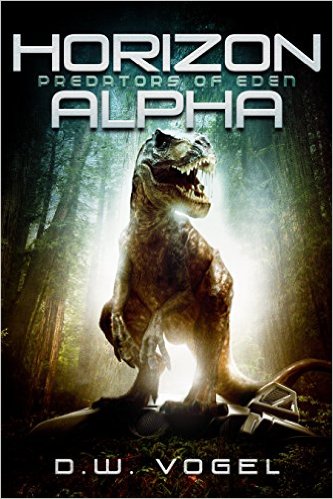
#OccasionalBookReview: Horizon Alpha: Predators of Eden by D.W. Vogel

Review - Horizon Alpha: Predators of Eden by D.W. Vogel

Horizon Alpha: Predators of Eden  by D.W. Vogel is a completely plausible future scenario for planet Earth and its inhabitants.

After fleeing doomed Earth for another earth-like planet, a group of survivors who happen to be low on adult men, have to rely upon a group of teenage boys to find a lost power source for their camp among ship wreckage in the jungle. They have to avoid creatures that they comparably deem “dinosaurs” as they carry out their search.

Although I enjoyed the story myself, and it’s worthy of a read by any demographic, it should be especially appealing to young boys looking for an adventure with a relatable hero.

Just spitting it out

I’m learning to spit it out. I think…

Actually, I may have already been doing it. My writer friends say, “Just get it down,” when really, I think I already have it down and what I’m really doing is refining and/or editing.

When I have an idea, sometimes it’s pretty involved and writing it down can get pretty lengthy. As I’m referring back to my “notes,” in some places I see where I’ve written a page and a half of what might be synopsis. Wouldn’t that be considered spitting it out? I’m writing the story down. It just doesn’t have all the details. So then, when I go back to fill in the particulars, isn’t that refining?

Hmm…

Maybe “spitting it out” is open to interpretation. In that case, I’ll keep on keeping on.

The Problem with Pantsing

Sometimes I wish I was a pantser. I have peers who can sit down and make it up. They can spit it out as it flows. They can Stephen King it all the way to the end.

Unfortunately, I’m a plotter. It could have something to do with my control issues. I like to think ahead. I like to know what’s coming. Forewarned is forearmed. I don’t want to be surprised at something that arises in my character’s arc unless I decide to make a hard left on my way from point A to point B. That being said, I do tend make some of it up as I go, but even that is improvising on my way to the predesignated landing place. Inspiration make strike, but it’s still filling in the gaps toward the next plot point.

I need to first have a destination, and then figure out how I’m going to arrive. I need to know where the party is, and then figure out how I’m getting there. I can’t sit at the keyboard with “no particular place to go.” That’s a setup for mindless web surfing or a Candy/Soda/Jelly Crush binge.

Maybe the plotting really isn’t unfortunate, though. It makes my logic more concrete. It keeps me accountable for the development and actions of my characters. It helps me maintain a solid cause/effect relationship. It satisfies my control issues. And it keeps me from rambling on for several literary millennia. Not mentioning anybody who does, though…

Richard B. Riddick: Poster Child for Badass. Not So Much Anymore…

Richard B. Riddick. My favorite hero archetype. The dictionary entry for what defines credible and incredible in a badass character. Until…I just finished watching Riddick, the third installment in the trilogy of movies about Richard B. Riddick.

It. Was. GAR-BAGE! I mean, I can’t even…

As much as I had anticipated seeing it, and as long as it took me to get around to it, my disappointment trumps my anticipation. It was so bad, I couldn’t sit through it a second time to decide what exactly I wanted to say about it in my blog post. it. I’ve seen The Chronicles of Riddick countless times, and this follow-up undermines into the realm of stupidity everything I enjoyed about installment two of the live action series.

That whooshing sound you hear is my sigh of relief that it’s over.

The Price of My Literary Soul

So it’s 2012.
About two weeks ago, I finally caught a piece of the namesake movie. I managed to watch around fourteen minutes beginning with the race to the airplane, continuing with the harrowing escape dodging falling skyscrapers and yawning cracks opening in the earth, and ending at the point where John Cusack is racing away from where Woody Harrelson was just FUBAR’d by Mother Nature and does a Kick Buttowski over a trench with the already falling apart RV. Um, yeaaah…
Who wrote this foolishness? Better yet, who ENJOYED this foolishness?? Maybe I just came in at a bad moment. Maybe I missed the hook. Maybe I should have read the reviews before I wasted fourteen minutes of my life watching any of it! Maybe I could churn out a piece of crap screenplay and have a major movie house spend $200 million dollars producing it!
Not likely. Would sacrificing my literary soul be worth being forever scarlet lettered by a piece of work that made money but was piece of artistic crap, packaged all glossy to distract you from its lack of credible content?
I would rather listen to Jessica Simpson sing Christmas carols all year long. :/
So… I will keep on keeping on, trudging through my manuscript until I have it right. Until I have a piece of work that I, in my heart of hearts, believe is reader-worthy. I owe that to my potential audience in the same way I feel that my favorite author owes it to me, to continue to produce quality stories that hold my interest and fan my imaginative fires.
And while I’m at it, I need to write to DirecTV and tell them to stop wasting my subscriber dollars by airing that foolishness over and over…

#Amwriting the Hard Way

My story is complete. It’s just not completely written.
I have tens of thousands of words of plot that I have committed to paper or Word document or OneDrive while feeling particularly inspired over the last couple of years. As a result, I have a whole story from front to back. I can answer every question there may be about my story. My conflict, my resolution, my character relationships, my backstory, my world and its history. Even my backstory has backstory – but that’s probably somewhere down the road.
So I now that I have a complete story, on to the manuscript. This is the hard part for me. Crafting my storyline into a novel. I am a perfectionist. Not in the I am perfect sense, but in the it has to be right sense. For me, this means that before I write anything new, I have to start from where I began and read everything over with fresh eyes for consistency, accuracy, color, tone, pace, POV and plain old how-does-it-sound. I correct typos. I fill in left out words and take out the unnecessary ones. AFTER, I have critiqued and edited my own writing, I then move on. By then, I am re-involved in the storyline and am moving with it.
While this method really works for me in terms of being able to pull out a page or two at any given point in time to demonstrate my work and writing style, it is laboriously slow in the production department. I have a tendency to creep along with maybe 300-500 words at a sitting. Sometimes that might include the editing! I do, however, feel a particular satisfaction after reading through what I’ve already written and can’t find anything to improve upon.
I never fail to be amazed when someone says “I wrote 1200 words today.” Or even more so amazed at 2000 words in a day! Maybe if I didn’t have a day job or a three-year-old, a husband, and a boxer, it might be different. Maybe I’m doing it all wrong. The only times I have ever been able to sit down and peck out 1000 words was when I was inspired about a storyline and I needed to commit the ideas into notes. Oh, I could easily give you 1000 words then! Maybe even 1500. And even though I wasn’t really thinking about the words I used, or sentence structure, or consistency, or color, it STILL took a good while to accomplish.
So then I wonder… When other writers are doing it 1000 words at a shot, are they really writing the manuscript, or just the story? Sometimes I sit there with my fingers on the keys waiting for the right descriptive words. I’ve already covered the plot and what’s going to happen, now I just need to make it interesting. I’ve read the work of a few others who are a little greener than I am in the writing arena, and their stuff read like a synopsis. One guy in particular was a prolific writer who could sit down and bang out story after story. But his stories read like my plot notes. I’m not saying that he’s a bad writer, just maybe really young at it and in need of more practice and development.
At any rate, by the time I finish my current chapter, it will be tidy without any reason to look back unless I just want to refresh a bit. That’s how I like it. That part’s done, now let’s put it away and move on. And when it’s time for the rewrite, hopefully there won’t be much to do.

Mental Pictures and the Writer’s Eye

The same way a movie producer translates the words into moving picture, I feel that as a writer, it is my personal responsibility to translate the visuals of the world into words, even if I am my only audience. I also think that when I offer an explanation, I need to be descriptive to be clear and avoid misinterpretation. I am, admittedly, better at this on paper than I am verbally.
My DH tells me nearly every day that I use too many words when I verbally relate a story and that the writer in me is taking over. It never fails to irritate him that I find it difficult to answer a question yes or no. I always feel the need to explain, and it is simply not black or white as he would have it. Life is conditional! Conditions exist! There is far more to life than his tunnel-visioned black or white. How monotonous would day and night be without the gloriously varied transitions that are sunrise and sunset? My gray areas in between my husband’s black and white are not gray at all. They are rich and colorful and varied. I’m not just cold. My fingertips are icy. My toes are going numb. I have a deep rooted chill that I just cannot shake. It has come to the point where he will preface a question with “This is a yes or no answer…”
Ron, with his own lack of color would say, “Man, I don’t feel good…” I would then ask, “What’s wrong?” and he would say, “I don’t feel good.” Didn’t we just cover that part? Exactly what does “don’t feel good” mean? Does it mean you’re lumpy and scratchy to the touch? Does it mean you’re cold and slimy? Does it mean that if I embraced you, your sharp and awkward angles would spoil the experience?
The other morning, I drove to work through a fog that felt like evil itself had blown its breath over the Tri-state. The cars ahead of me were increasingly less visible as they left me alone to fend for myself in the blindness. Meanwhile, the daytime running lights behind me were disembodied eyes following me in the mist, awaiting their moment to overtake me. Hoards of evil minions raced along unseen in the median waiting for some unfortunate traveler to pull over onto the shoulder. The mist swirled and licked at my G6 as it sliced smoothly through the gray.
My husband would say, “Man, it’s foggy out here!” And I would answer, “It sure is.” HE is not my audience. He doesn’t understand or appreciate the eyes of a writer and how we interpret the world. It’s not just our oak tree; it’s my beloved young oak that just bore acorns for the first time this summer. It’s not just my stepdaughter’s car; it’s that money pit Ashley drives that has eaten up our vacation fund. It’s not just my job; it’s my mundane, bill-paying, stomach-filling occupation.
I recently opened an e-book to a story that began with “Once upon a time there was a house next to a bridge…” I was thinking, SERIOUSLY? It then went on to tell the story in a fact-finding way. This might have been a good book somewhere along the way, but I didn’t make it past page two, and on the e-reader you can see pages one and two at the same time!
It is my job as a writer and storyteller to paint the mental picture for my reader and allow them to become involved even if only as a spectator. My story should unfold in the movie theater of their mind, not just on the pages of the book. If I can do this well while telling a good, well-paced story, my readers will return.

Writer’s Block

So, I finally find a few minutes to write. I’m sitting there with my tidy and completely outlined story. I put my fingers in position on the keys to type, and I wait. Where are the words? I know exactly what I want to convey, but for whatever current reason, the words escape me. Actually, I think they’re avoiding me. It’s an eloquency conspiracy to keep me in my mundane, stomach filling, bill paying day job.

Wait, I know… I’ll go back to my notes. I’ll re-read some of the other things that I’ve written. I’ll look over the scribbles in the margins and my colored notes to self. Hey! There’s something I didn’t remember writing to myself!

Ohhh, it’s coming now! I feel the creative juices bubbling! Wait…

The bedroom door bursts open. It’s my 3 year old daughter all sleepy-eyed and not-quite-right yet. “MOM! I want juice. And fishsticks. Juice and fishsticks.”

Duty calls…

To Prologue or Not to Prologue…

Again, I’m relatively new to the business end of writing. The website, blogging, twittering, etc. I have recently found Jane Friedman (who appeared to be quoting Kathleen Ortiz – but I might be wrong in my fledging interpretation) on Twitter, who caught my eye with a piece of advice in a tweet that rung especially true for me.

“Never say: ‘Let me start w/backstory.’ Your story doesn’t start in the right place if that’s necessary.” (@JaneFriedman/Twitter/July 29) My original story is somewhere in the middle now, or maybe even closer to the end, because I ran into the problem of having to explain.

While reading a profoundly successful author’s 12 book fantasy series, I found myself PAINFULLY trudging through PAGES of monologue, through which the main character would explain the whys and whatfors. This particular author’s first book was 848 pages in length. About half an inch through it in paperback, I put it down for an entire year before I picked it up again to finish. His writing style was wordy and long and drawn out and took waaaaay too long to get to a point. While very detailed in his world and characters, he was much too preachy, AND, after 12 ginournous volumes/episodes, the ending was lame. For me, it was the kind of letdown you expect from the silver screen ala True Lies when it started getting silly and unrealistic on the big screen adventure scale after a perfectly entertaining spy movie. (Sorry, I digressed there…) Personally, I think he could have subscribed to the “less is more” philosophy in his attempts to paint a visual picture. Maybe one or the other – monologue or wordy descriptions, but not both.

Have you ever actually read The Lord of the Rings? I haven’t. But I have attempted to listen to it on audiobook. IT…WAS…PAINFUL! I never even made it to the Prancing Pony! On the other hand, I own and have watched all three movies in the series multiple times. While I have the utmost respect for Tolkien as a master and for his artistry, I am eternally grateful that someone had the foresight to give us an abridged movie version that still turned out to be a series of three LONG chapters!

At any rate, I struggled with exactly how to give my readers the needed filler detail so that my story made sense without being longwinded. Flashbacks? Nah, could be confusing. Long first chapter and then flash forward? Nah…still possibly confusing and cumbersone to pull off. An opening to every chapter with some “other story?” Nope…

SO, after much blog crawling and internet scouring, my answer was NOT to prologue, and instead create a front end story which blossomed into a novella, quite possibly on its way to a novel. Hence, First Witch. My storyline had gotten so broad with the need for the reader to understand, that I was able to create a whole new episode, giving life to my backstory while providing my readers the whys and whatfors relevant to later storylines.

The need to explain, I believe, is the perfect fodder for more written material. Anytime you find yourself in a position where you need to explain, consider more substantial story instead of more monologue…